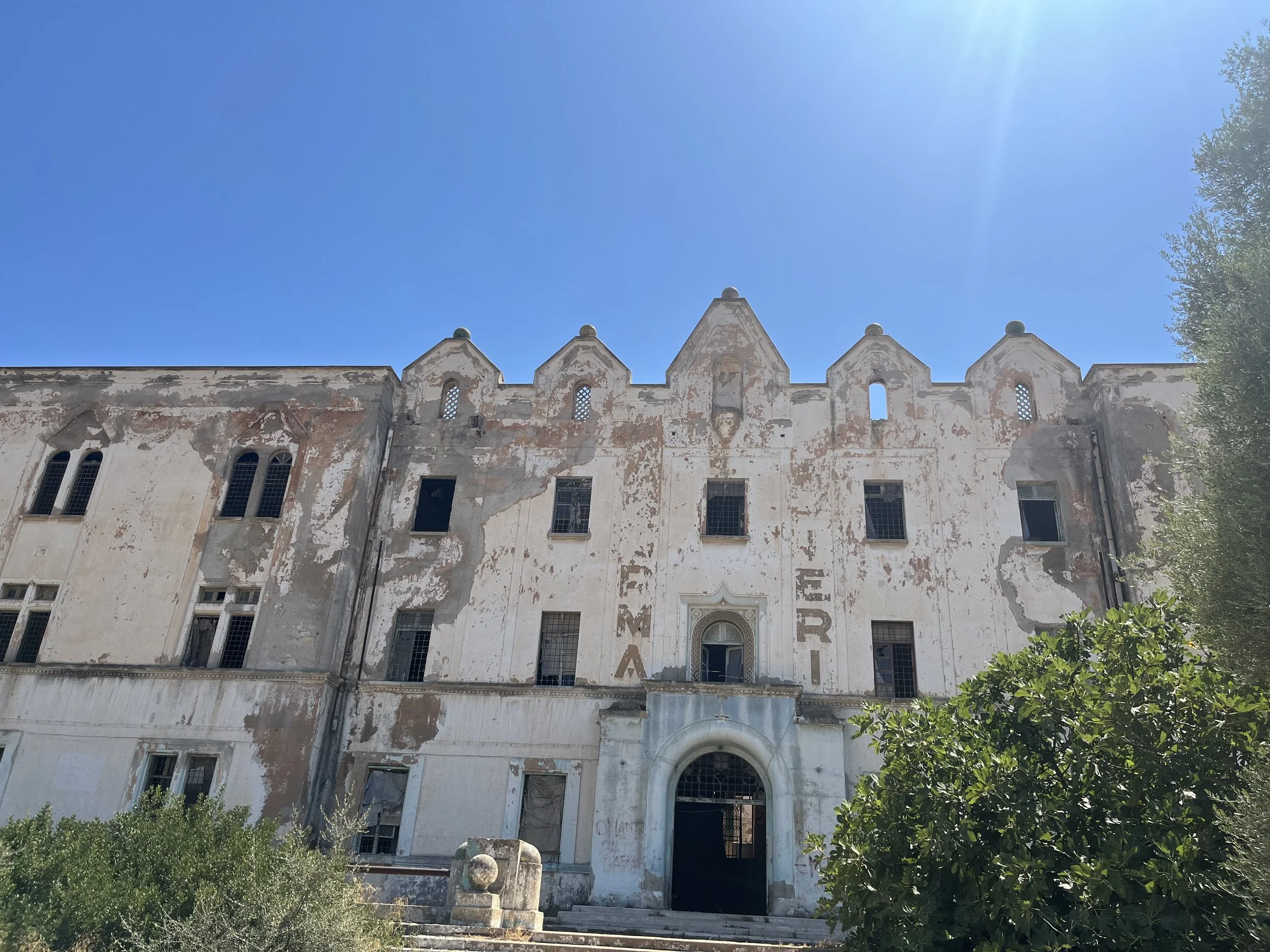
The writing and images in this project come out of my experiences and thoughts during my trip to Leros, Greece in 2024. These pieces were written as a part of a writing portfolio for an ethnographic writing graduate course. They are informed by my own knowledge of the island’s history, as well as in conversation with Eirini Avramopoulou’s article from the Journal of Modern Greek Studies (Volume 38, Number 2, October 2020) titled “Decolonizing the Refugee Crisis: Palimpsestous Writing, Being-in-Waiting, and Spaces of Refuge on the Greek Island of Leros”. As I am in the early stages of working towards my doctoral research, I am using this space to consider the island of Leros as one of local/migrant encounter, ten years after the so-called refugee crisis.
Λέρος μεσ’ την καρδιά, ω Λέρος, ένα κρύο μέρος…
Leros in my heart, a cold place
The song echoes through my mind as we wind through narrow rural roads, up the mountains and along the sea. I’ve grown up with this song, I’ve heard it hundreds of times. Dad wrote it for all those who were sent here, never to return home.
Leros is a small Greek island of the Dodecanese, one of the twelve islands close to Turkey. Its dry, rugged mountains meet crystal blue waters. A few kilometres out from the village of Lakki, which was once the base for Italian Fascists during World War II, sits the former Leros Psychiatric Hospital. Its dilapidated exterior looms over the sea. I’m here on vacation, but I have to visit the hospital.
As we pull up through the gates and drive down the winding roads, I imagine what it would be like to be living in such an isolated place. It was first opened as a psychiatric hospital in the late 1950s, and was officially named the Colony for Psychopaths. Psychiatric and handicapped individuals were sent here and forgotten by their families on the mainland. During the military dictatorship of 1967-1973, political dissidents were also exiled to this place. More recently though, the space directly in front of the hospital served as a hotspot for migrants during the 2015 so-called refugee crisis.
We park the car and I step out, surrounded by silence except for the buzzing of cicadas in the summer heat. A warm breeze blows some forgotten sheets hanging from one of the windows of the hospital. It’s so quiet and empty, but somehow the weight of those who have passed through here still lingers. We walk up the steps to the entrance of the hospital and look down over the makeshift refugee camp before us. On the mountain directly above, the newly opened Closed Controlled Access Centre functions to keep recently arrived migrants even further isolated from locals and tourists. This place has been a prison for so many.
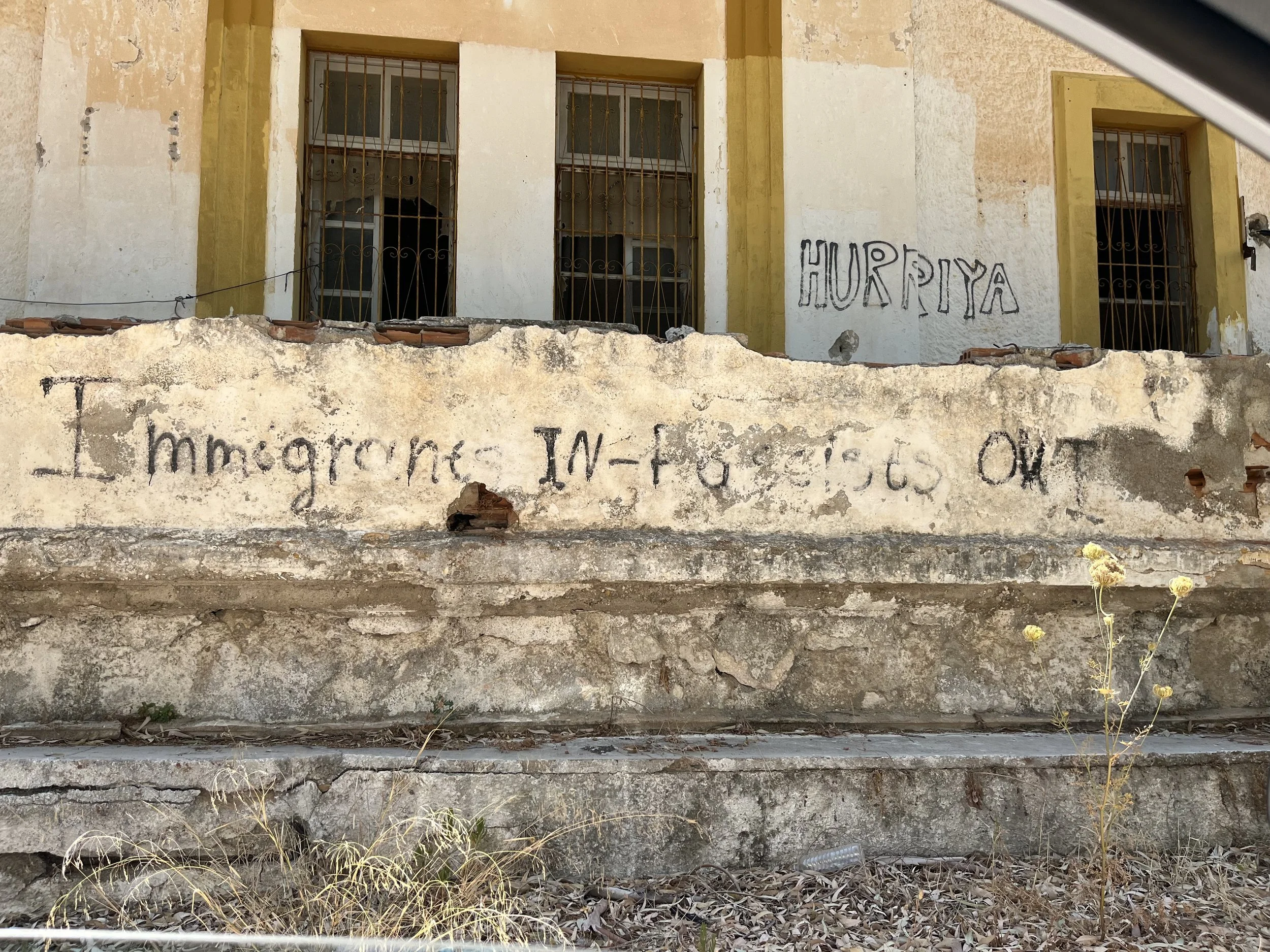
Graffiti covers the walls both inside and out, in a mix of Greek, English and Arabic. On the concrete wall across from the main building, in faded spray paint, someone has written “Immigrants In - Fascists Out”.
All along the grounds socks, shoes and other items of clothing litter the fences and steps. Who were these people that lived here? What remains of them? Over the years, people were confined within these walls, for different reasons, but it has always served as a sort of prison.
I take a few moments to sit in the silence. In the distance, I can hear the hum of an electric scooter getting closer and closer. It sounds like it’s coming toward us. A man wearing a t-shirt that says “Security” rides up to us on the scooter.
“What are you doing here? Don’t go inside, the building is not safe”, he says.
We tell him we’re here to look around. I think he’s come to make sure we’re not journalists or squatters. Even though it’s abandoned, it’s still patrolled, still under surveillance. Not many people know about this place, not even those in Greece. Greece likes to hide their darkest parts of history from the national imaginary.
“Fine, don’t stay too long though. You better not be here when I come back around in ten minutes”, he says with suspicion in his eyes.
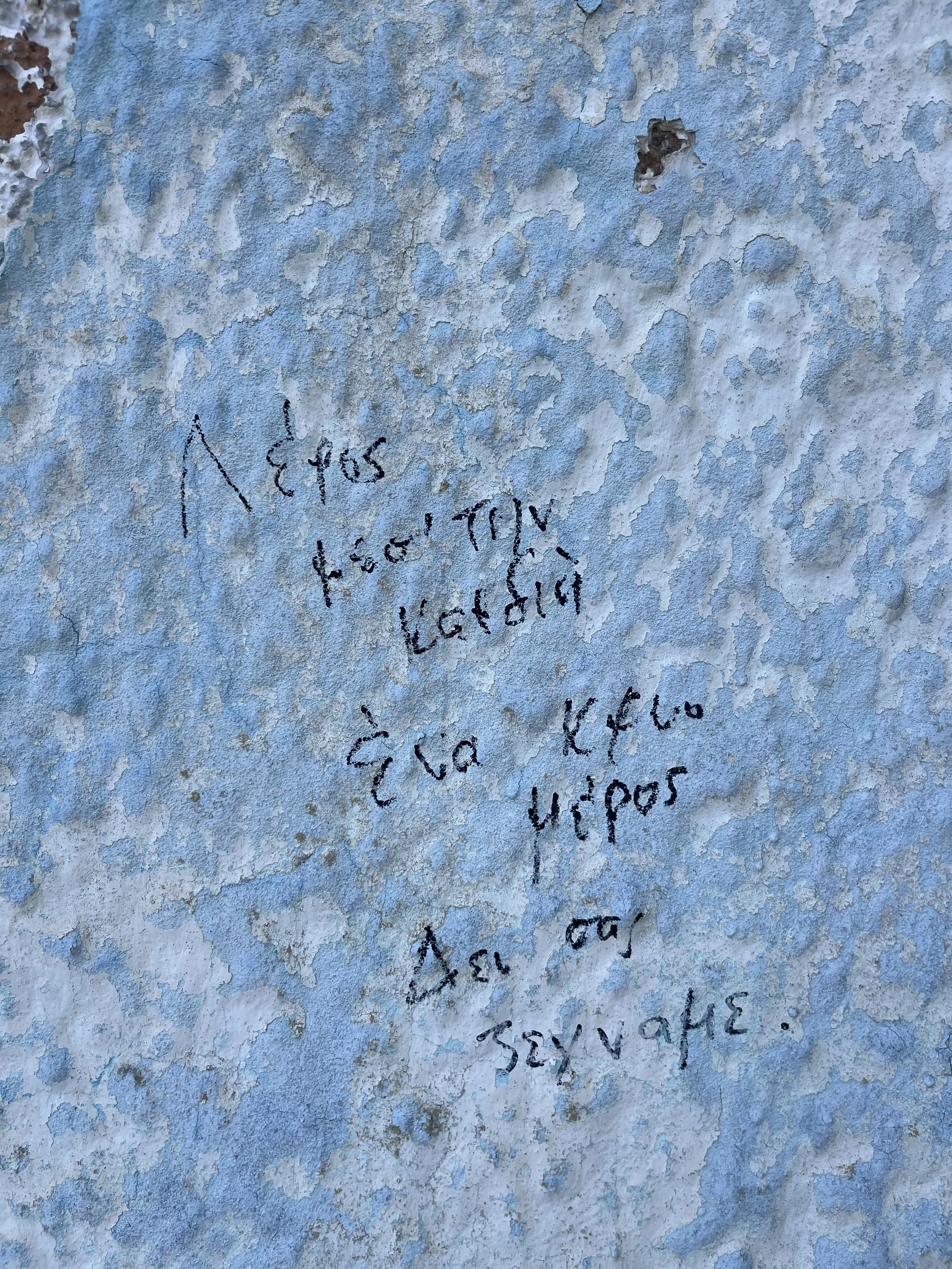
As soon as he drives off, I walk up the steps and take out the marker I have in my pocket.
Λέρος μεσ’ την καρδιά
ένα κρύο μέρος
Δεν σας ξεχνάμε.
Leros in my heart
A cold place
We won’t forget you.
Dad’s song brought me here. As I write on the wall, I am filled with emotion. For those who were brought and left here to be forgotten by those close to them, but also forgotten in history.
1960
They say I’m not well,
That I’m here to get better.
How long will I be here?
Will I ever go home?
My arms, my feet
Strapped down to the bed.
Women in white
Come in and out of the room
Poking
Prodding
my skin.
Others are wheeled in
Some are wheeled out
All are strapped in
By the arms, by the feet
A singular window sits high above us
Is it raining?
Is it sunny?
Is it warm?
Is it cool?
Rows of beds
Line the room
Some lie quietly
Staring at the ceiling
Some squirm
And Scream
All of us wondering
How long will I be here?
Will I ever go home?
Three Voices, One Prison
1970
They don’t care about us.
They never cared about us.
Fascists, all of them!
The irony that they didn’t want the Italians here
During the War
Now they’re doing the exact same thing!
Oppressing us
Silencing us
Killing us
They’ve brought me to this hellhole
To shut me up
2016
The sun is so hot
Sweat beads through my shoulder blades
Down my back
My sister stands beside me
Frozen in place
Eyes staring up at the abandoned building
Where have they brought us?
The line in front
Moves slowly
Guards yell
In a language I don’t understand
Yesterday, we were on a small boat in the middle of the sea
Last night, our boat was stopped
Blue lights flashed on the water
One by one
They picked us up off the boat and lined us up into theirs
And brought us here
Where we’ve been waiting
For twelve hours
They hand us water bottles
As they patrol up and down the line
Large guns strapped across their bodies
I come face to face with the guard
Holding the notepad
Look up into his cold, dark eyes
Like me,
He speaks broken English
“Why have you come to Greece?”